Description
Defend the Code You Write. Protect the Systems You Build.
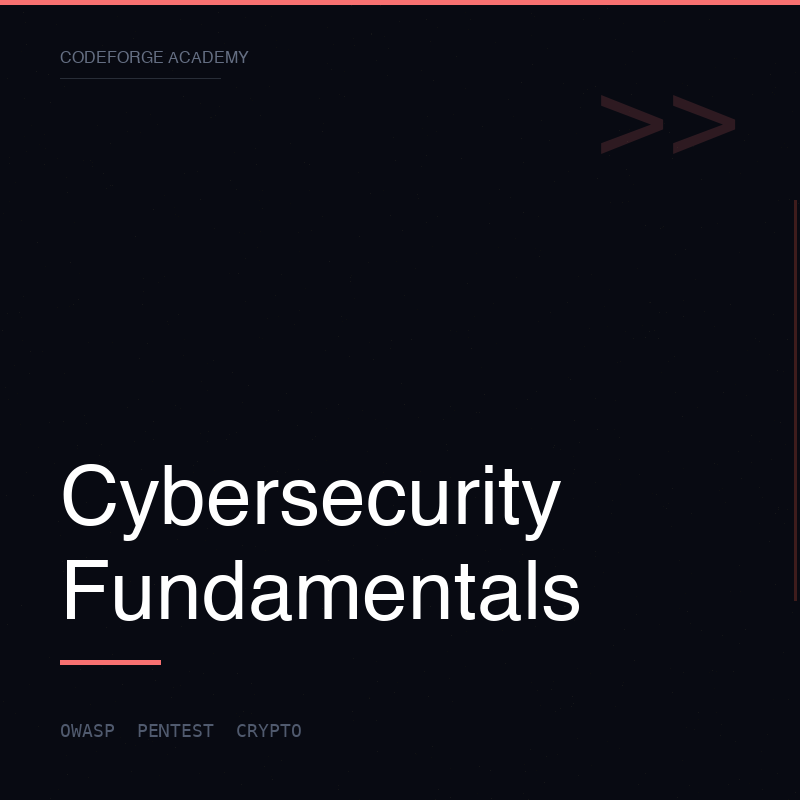
Every developer ships vulnerabilities — until they learn not to. The Cybersecurity Fundamentals Path teaches you to think like an attacker so you can build like a defender. Over 12 weeks and 22 modules, you’ll learn to identify, exploit, and fix security vulnerabilities across web applications, networks, and infrastructure — the skills that make you invaluable to any engineering team.
What You’ll Build
- Vulnerability Scanner — An automated tool that scans web applications for OWASP Top 10 vulnerabilities, generates risk reports, and suggests remediation steps
- Secure Authentication System — A hardened auth implementation with MFA, brute-force protection, secure session management, and comprehensive audit logging
- Capture The Flag Challenges — 30+ CTF-style challenges covering SQL injection, XSS, CSRF, SSRF, insecure deserialization, and privilege escalation
- Security Audit Report — A professional penetration testing report for a deliberately vulnerable application, complete with executive summary, findings, risk ratings, and remediation roadmap
Curriculum Overview — 22 Modules
Security Mindset (Weeks 1–2): Threat modeling and attack surface analysis, the CIA triad and security principles, OWASP Top 10 deep dive, security headers and browser security model, same-origin policy, CORS, and CSP
Web Application Security (Weeks 3–6): SQL injection — detection, exploitation, and prevention, cross-site scripting (stored, reflected, DOM-based), cross-site request forgery and state-changing attacks, server-side request forgery (SSRF), insecure direct object references and broken access control, file upload vulnerabilities, authentication and session management flaws
Cryptography & Network Security (Weeks 7–9): Symmetric and asymmetric encryption, hashing algorithms and password storage, TLS/SSL and certificate management, network scanning and reconnaissance, wireless security fundamentals, VPNs, firewalls, and intrusion detection
Offensive Security (Weeks 10–11): Penetration testing methodology, reconnaissance and information gathering, vulnerability exploitation with ethical boundaries, privilege escalation techniques, post-exploitation and reporting, responsible disclosure practices
Defensive Engineering (Week 12): Secure coding practices and code review, dependency scanning and supply chain security, security in CI/CD pipelines, incident response fundamentals, compliance frameworks overview (SOC 2, ISO 27001, GDPR), building a security-first engineering culture
What’s Included
- 22 structured modules with isolated lab environments
- 30+ CTF challenges in a safe, sandboxed environment
- 4 security-focused projects and assessments
- AI-powered secure code analysis
- Private security community channel
- Certificate of completion
- Lifetime access to all materials and future updates
Who This Is For
Developers who want to write more secure code, aspiring penetration testers and security analysts, DevOps engineers implementing security practices, engineering managers building security-aware teams, or anyone preparing for security certifications (CompTIA Security+, CEH, OSCP). Basic web development knowledge recommended.
Reviews
There are no reviews yet.